Human authority & privacy.
Privacy is preserved by architecture, not by policy. Human authority is preserved by the Time Sovereignty Layer, not by procedural reminder.
Human-Non-Modeled / Context-First
A foundational refusal: the platform does not model individual humans. No persistent representation of any person across decisions. It reads context — institutional, situational, operational facts — and applies deterministic policy to it.
It never accumulates a feature vector saying “Person X is likely to do Y”. It does not score people or build profiles. The unit of governance is the action, not the person.
Zero PII retention by design
Personal identifiers are not retained in the chain. Where an authorized input includes PII — a federation API identifying an official by name and licence number — the IML maps it to a policy-relevant role token before it enters the kernel. The chain records the token; the PII never becomes part of the durable record.
More conservative than most frameworks require. An audit chain that retains PII is a liability surface; one that records role tokens is an asset.
No profiling of individuals
No association of an observed signal with a previously seen instance of the same person. No facial recognition. No re-identification across decisions. Where continuity is necessary — a multi-step authorization — it is carried by an authorization token, not a person identifier.
Recovery paths under human authority
DEFER and SYSTEM_UNVERIFIED are not failures. They are pause states with a stated gap and a defined escalation to a named human within scope. The recovery path is part of the design, not an afterthought — the kernel says what is missing and what leads back to ALLOW.
Time Sovereignty: irreversible actions require human authorization
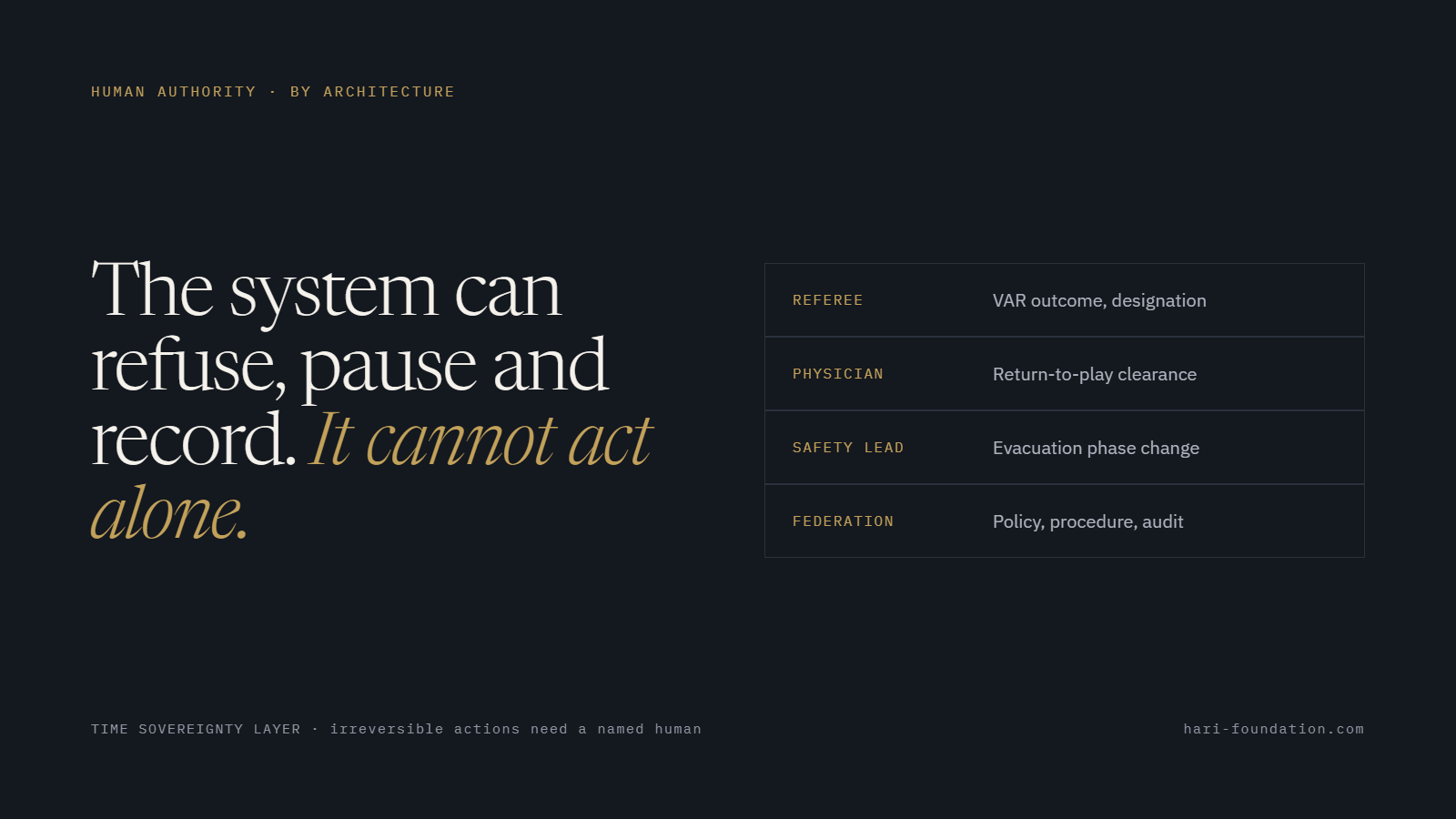
A return-to-play clearance that triggers selection. An evacuation phase that mobilises responders. A protocol amendment affecting an enrolled cohort. For actions classified irreversible by policy, the Time Sovereignty Layer requires explicit, signed, in-scope human authorization before anything proceeds.
The authorization is itself written to the chain — the named human, their scope, their signature, the time. The system can refuse, pause and record. It cannot, by architecture, take an irreversible action on its own initiative.
See it applied.
The same guarantees, vertical by vertical — Football first.