What is H.A.R.I.
The canonical definition, the functional layers, and where the platform sits in a high-stakes AI environment.
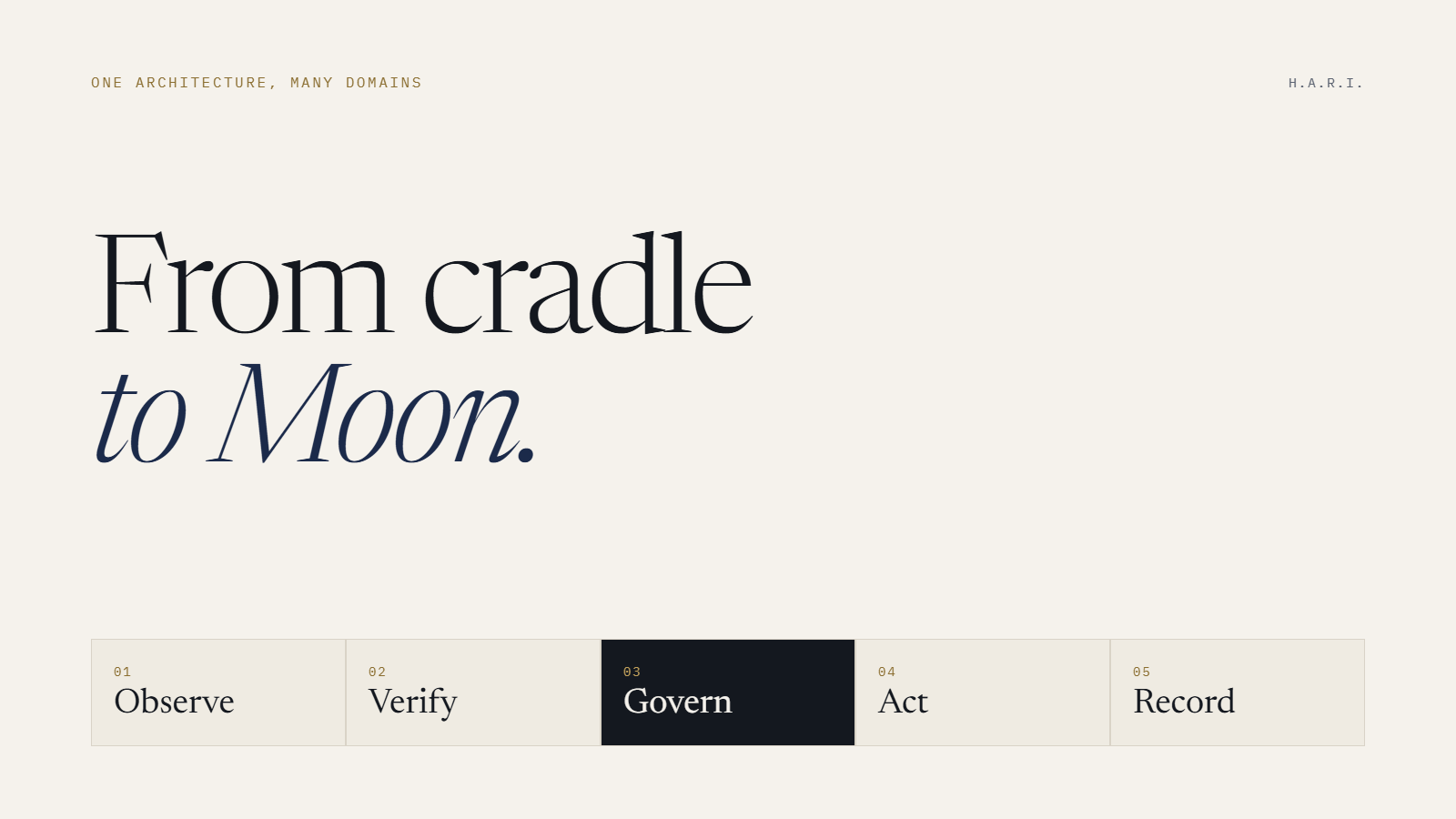
Designed to supervise, coordinate and safeguard complex AI-driven environments in a human-centric, privacy-preserving way.
The problem
High-stakes AI environments — football governance, clinical research, stadium safety, critical infrastructure — share a structural failure mode: the systems making consequential decisions are probabilistic, opaque and irreproducible. The same input does not always produce the same output. Decisions cannot be replayed. Audit trails are partial, scattered across vendors, and frequently broken at the boundary between a model’s output and the action that follows.
This is not a research problem. It is a governance problem. Regulators, auditors, insurers and institutional principals do not have a deterministic layer to point to. Without one, accountability collapses upward — to whoever deployed the model — or sideways, into providers who cannot be held to the institutional standard.
The approach
H.A.R.I. is not another model. It is a deterministic middleware layer between AI systems, data, sensors, APIs and the consequential actions they affect. It does not generate. It does not classify. It does not score. It governs.
For every action that crosses the layer, H.A.R.I. produces one of three canonical outputs — ALLOW, DEFER or SYSTEM_UNVERIFIED — together with a hash-chained, signed record of the inputs that produced the decision. Same inputs, same output. Any decision can be reconstructed from the chain. Irreversible actions require explicit human authorization within an identified scope.
And neither DEFER nor SYSTEM_UNVERIFIED is a blind wall. Every non-ALLOW output carries a recovery path: which evidence is missing, which source must be verified, which named authority must decide — and what would make the decision evaluable as ALLOW.
The layer between intent and consequence is reproducible, signed and reviewable. That is what makes the platform institutional rather than experimental.
Functional layers
A small number of architectural layers, each with a single responsibility. Boundaries are explicit so that scope, audit and validation can be reasoned about per layer.
SYSTEM_UNVERIFIED rather than producing a guess.DEFER and SYSTEM_UNVERIFIED are not failures. They are pause states with a stated gap and a defined escalation: what is missing, who resolves it, and the path back to ALLOW.Recovery, not refusal.
Most governance systems stop at “no”. H.A.R.I. treats a non-ALLOW output as an unfinished decision with a known completion path. Each state answers three questions: what is missing, who can supply it, and what happens once it is supplied.
Next: the action proceeds; decision, inputs and policy version are written to the chain.
Next: the kernel names the role, hands over the evidence already on file, and re-evaluates to ALLOW once the signed authorization arrives.
Next: the kernel lists exactly which evidence would make the decision evaluable, and re-runs deterministically when it is obtained.
SYSTEM_UNVERIFIED · policy v4.2 · episode E-2291
missing: camera angle B (touch moment), own-half context
recovery: bind feed CAM-B to E-2291 → re-evaluate
authority: match official (in scope) — not delegable
on completion: deterministic re-run → ALLOW | DEFER
The recovery path is itself part of the signed record: an auditor can see not only what was decided, but what was missing and how the gap was closed.
Technical foundation
Conservative, well-understood primitives. Boring components in a verifiable arrangement are stronger than novel components in an unverifiable one.
SOV-2026-02-26.Where H.A.R.I. sits
H.A.R.I. is institutional middleware. It does not replace the AI systems, data sources or operational tools an organization already runs. It is the deterministic layer between those systems and the consequential actions they participate in.
Read the architecture. Then talk.
Full technical documentation is available under mutual NDA. Pre-NDA discussions cover architecture-level material only.